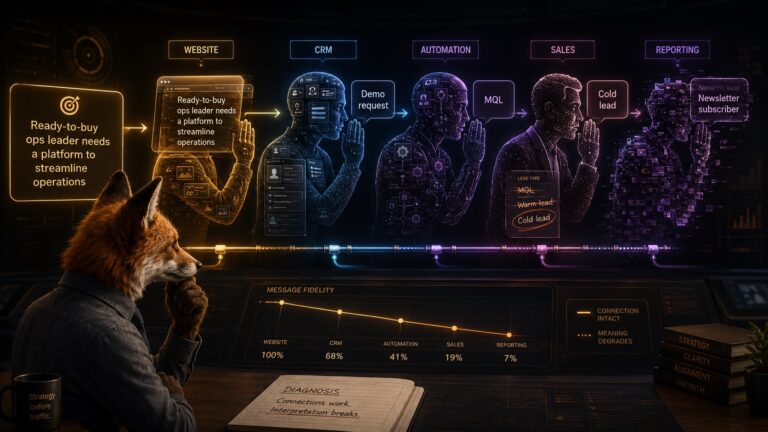
If you are looking for a marketing automation agency, chances are marketing has started to feel heavier than it should.
- Leads are coming in, but follow-up is inconsistent.
- Campaigns are running, but outcomes are hard to trace.
- Tools are in place, yet teams still rely on spreadsheets and memory.
Marketing automation is meant to reduce this friction, not add to it. When done properly, it turns busy marketing into a system that runs quietly in the background and supports real progress.
This article explains what marketing automation services actually involve, how automation and AI are used responsibly, and what to look for in an agency that values clarity over complexity.
Improving customer engagement at the moments that matter
Strong customer engagement is rarely about doing more. It is about showing up in the right way, for the right people, at the right time.
A thoughtful approach to customer experience starts with understanding your target audience. What they care about, what they are trying to achieve, and where friction tends to appear. When those signals are clear, engagement feels natural rather than forced.
Automation and content play a supporting role here. They help ensure people receive relevant information when it is useful, not when it is convenient for the business. That might be a follow-up after meaningful interaction, a reminder that aligns with buying intent, or helpful guidance that removes uncertainty.
When engagement is timed well, it builds trust quietly. Customers feel understood, interactions feel considered, and the overall experience becomes easier. Over time, this consistency is what turns one-off interactions into lasting relationships.
Orchestrating campaigns across channels, not silos
Strong marketing automation campaigns do not rely on a single touchpoint. They bring channels together so each interaction builds on the last.
This often starts with landing pages designed for clarity rather than persuasion. A clear message, a focused next step, and a structure that reflects intent. When landing pages are aligned with campaigns, conversion becomes a by-product of understanding, not pressure.
From there, automation allows digital marketing activity to unfold in a data-driven way. Engagement across social media, website visits, and form submissions informs what happens next, rather than treating every prospect the same.
Email marketing plays a central role here. Well-designed email sequences support momentum by continuing the conversation over time, adapting to behaviour and readiness. For some use cases, SMS adds a timely, lightweight touchpoint when immediacy matters, such as confirmations, reminders, or high-intent follow-ups.
When these channels are orchestrated together, automation feels intentional rather than intrusive. Each message has a reason to exist, each step has context, and campaigns work as a system rather than a collection of disconnected actions.
Bringing structure to marketing without adding complexity
As organisations grow, marketing efforts often become fragmented. Tools multiply, campaigns overlap, and even a strong marketing team can struggle to keep everything aligned.
This is where a clear marketing automation strategy matters. The goal is not to add more tools, but to bring structure to how work flows through the business. Well-chosen marketing automation tools and marketing automation software support existing marketing processes instead of forcing teams to work around them.
Effective marketing automation solutions focus on consistency. Follow-up happens when it should. Data is shared cleanly. Campaigns run without relying on memory or manual intervention. The marketing team spends less time managing mechanics and more time thinking about impact.
When automation is applied thoughtfully, it simplifies rather than complicates. Processes become clearer, effort is better directed, and marketing starts to feel coordinated instead of reactive. That is when automation earns its place, quietly supporting momentum in the background.
Supporting the sales funnel without forcing the pace
A well-functioning sales funnel is not about pushing people through stages faster. It is about removing uncertainty so progress happens naturally.
This is where lead nurturing plays a quiet but important role. Not every prospect is ready to act immediately, and that is normal. Thoughtful follow-up, relevant content, and well-timed touchpoints help maintain momentum without creating pressure.
When nurturing is aligned with intent, conversion rates tend to improve as a by-product. Prospects arrive at conversations better informed, more confident, and clearer on what they need. Sales teams spend less time explaining the basics and more time addressing real questions.
Clean CRM integration underpins all of this. When data flows reliably between marketing and sales systems, there is a shared view of where each opportunity sits. Follow-up becomes more consistent, handovers are smoother, and nothing falls through the gaps.
The result is a funnel that feels considered rather than aggressive. Leads move forward when they are ready, supported by systems that do their job quietly in the background.
What’s typically included in effective marketing automation
Good marketing automation is not one thing. It is a set of connected components that work together to support consistency, relevance, and momentum across channels.
At the centre are marketing automation campaigns designed to respond to behaviour rather than assumptions. These campaigns are data-driven, using real engagement signals to determine what happens next instead of relying on fixed schedules or guesswork.
Landing pages play a critical role here. They provide a focused environment for conversion, aligned to the message that brought someone there. When landing pages are built with intent in mind, they become a natural extension of broader digital marketing activity rather than isolated assets.
Channels are then coordinated to support the journey. Email marketing remains a core component, with structured email sequences guiding prospects over time based on interest and readiness. For some use cases, SMS adds a timely, lightweight touchpoint when immediacy matters, such as reminders or high-intent follow-ups.
Social media often feeds the system at the top, helping attract attention and re-engage audiences already familiar with the brand. When social activity is connected to automation, it reinforces messaging instead of competing with it.
The common thread is intent. Each element exists for a reason, each interaction has context, and automation supports the conversation rather than overwhelming it. When these pieces work together, marketing automation feels considered, not mechanical.
Reducing manual effort without losing control
Marketing teams spend more time than they realise on marketing tasks that add little strategic value. Follow-ups, list updates, handovers, and reporting all need to happen, but doing them manually quickly becomes a drain.
This is where automation earns its keep. By taking care of repetitive tasks, teams can streamline how work flows through the system without sacrificing quality or oversight. The aim is not to remove people from the process, but to remove unnecessary friction from it.
Well-designed automation processes ensure that routine actions happen consistently and on time. Leads are routed correctly, follow-up is triggered when it should be, and information is captured without relying on memory or manual intervention.
When these foundations are in place, marketing teams gain back time and focus. Effort shifts from managing mechanics to improving strategy, creativity, and performance. Automation does the background work quietly, allowing people to concentrate on what actually moves the needle.
How a marketing automation agency improves lead generation
Lead generation rarely fails because there are not enough leads. It fails because momentum is lost.
Marketing automation helps by:
- Responding to enquiries immediately
- Making sure no lead is forgotten
- Segmenting contacts based on behaviour, not assumptions
- Supporting longer decision cycles without pressure
Instead of relying on one conversion moment, automation supports the entire journey. Early interest is nurtured. Sales-ready leads are prioritised. Everyone else is kept engaged without being chased.
The result is better leads, not just more of them.
What marketing automation services should you expect?
A specialist marketing automation agency usually works across a few connected areas.
Strategy and system design
This is where clarity is created. Journeys are mapped, triggers are defined, and success is agreed upfront.
CRM and platform setup
Automation only works when it integrates cleanly with a CRM. Sales and marketing need a shared view of reality, not competing dashboards.
Common platforms include HubSpot, Salesforce, and ActiveCampaign, but the right choice depends on scale, complexity, and internal capability.
Workflow and campaign automation
This is where journeys are built. Lead scoring, routing, and logic are designed to reduce friction, not create clever but fragile systems.
Email and content automation
Templates, personalisation rules, and content logic ensure communication stays human, even when it is automated.
Reporting and optimisation
Automation should improve over time. Performance is reviewed, friction points are identified, and systems are refined.
Can you migrate data from one CRM to another?
Yes. And it is often overdue.
CRM and automation migrations usually happen when:
- A business outgrows its existing setup
- Systems become fragmented
- Reporting becomes unreliable
A good marketing automation agency handles migration by:
- Auditing data quality
- Mapping fields and logic properly
- Cleaning and consolidating records
- Testing automation before launch
Migration is not just a technical exercise. It is an opportunity to fix decisions that no longer serve the business.
How Redfox uses AI in marketing automation
AI is part of modern marketing automation, but at Redfox it is never the headline.
Used well, AI supports clarity and efficiency. Used poorly, it adds noise, speed without direction, and decisions without context. Our approach is deliberately restrained.
We use AI as an assistant, not a decision-maker.
One practical use is assisting with content drafts and variations. AI helps generate first passes, alternative angles, or structural options more efficiently. Every output is reviewed and refined by humans to ensure it aligns with strategy, tone, and audience intent. Speed improves, judgement stays firmly in place.
AI also supports subject line testing by identifying patterns across engagement data and suggesting variations worth exploring. It helps narrow the field, not declare winners in isolation. Context still matters.
Another area where AI adds value is analysing engagement patterns. By reviewing large volumes of interaction data, AI can surface trends that would otherwise be easy to miss. This helps us understand what is resonating, where attention drops, and which behaviours signal increasing intent.
We also use AI to support segmentation and personalisation, grouping contacts based on behaviour rather than static labels. This allows communication to feel more relevant without overcomplicating automation or creating fragile systems.
The guiding principle is simple. Strategy comes first. Human judgement sets direction, defines trade-offs, and decides what matters. AI helps us execute that strategy more efficiently, without replacing the thinking behind it.
How do you measure success in marketing automation?
If success is measured by how complex the workflows look, something has gone wrong.
Meaningful measurement focuses on outcomes such as:
- Faster response times to new leads
- Improved conversion between stages
- Better lead quality and sales acceptance
- Reduced manual workload
- More consistent follow-up
If automation does not make things clearer and easier, it is not doing its job.
How marketing automation fits into the wider system
Marketing automation works best as part of a connected ecosystem.
It should integrate with:
- Your website and forms
- Your CRM and sales tools
- Content and SEO efforts
- Paid and organic campaigns
When everything connects, automation becomes the quiet link between activity and outcome.
Common mistakes that derail automation
Most automation failures are predictable.
Common issues include:
- Automating broken processes
- Over-segmentation that no one maintains
- Too many emails, not enough relevance
- Poor sales and marketing alignment
- No ongoing review
Good automation is restrained. It does less, better.
When marketing automation actually works
Marketing automation delivers real value when:
- The customer journey is understood
- Data is clean and structured
- Messaging is clear
- Teams agree on what a good lead looks like
- Automation supports people, not replaces them
In these conditions, automation reduces noise and increases momentum.
Who benefits most from marketing automation?
Marketing automation is not just for large organisations with complex systems. It is often most valuable for small businesses and SMEs where time, focus, and consistency matter.
For business owners, automation helps create breathing room. It supports clear business goals by ensuring follow-up happens reliably, opportunities are not missed, and marketing effort does not depend on constant oversight. Systems do the routine work, so decisions can stay focused on growth.
For marketing teams, automation brings structure. Campaigns are easier to manage, handovers are clearer, and activity aligns more closely with outcomes. Instead of juggling disconnected tools and tasks, teams can work within a system that supports planning and improvement.
Automation also supports the sales process. Leads arrive better informed, follow-up is more consistent, and conversations start with context rather than cold introductions. This reduces friction between marketing and sales and helps both teams work from the same view of progress.
In short, marketing automation benefits organisations that want to grow without adding unnecessary complexity. When systems are aligned to real goals, automation becomes a practical support for people, not another layer to manage.
Final thoughts
A marketing automation agency should not be selling complexity. It should be helping you regain control.
When automation is done properly, marketing becomes calmer. Follow-up becomes consistent. Decisions become easier. And growth feels less reactive.
The right agency helps you build systems you trust, not dashboards you avoid.